How Pickleball Paddles Are Made: From Carbon Fiber to a Finished Paddle
From carbon fiber and fiberglass prepreg to hot-press molding, trimming and final quality control — how a pickleball paddle is made, and what to check before you order.
A pickleball paddle has only three parts — face, core, and grip — but each one is tuned again and again. How the face material, the core, and the build process are combined decides power transfer, control, feel, and how long the paddle lasts.
1. Raw material preparation
Everything starts with the base material.
High-modulus carbon fiber and fiberglass prepreg are selected as the core face materials. Before anything is cut, the incoming material is checked:
- Carbon fiber cloth rolls are tested for tension and flatness.
- Prepreg is checked for resin content, fiber orientation, and areal density consistency, so that strength, toughness, and weight balance are controlled from the source.
- Curing behaviour is checked by DSC (differential scanning calorimetry), to confirm that each batch cures in the same way and stays stable from batch to batch.
This step matters because a paddle is a layered composite. If the resin, fiber direction, or weight of one layer is off, the finished paddle will not feel the same as the one before it.
2. Design and precision cutting
The paddle shape is not cut by hand from a template. It is designed first, then cut by machine.
- CAD/CAM design: The paddle structure is modelled and its mechanics are simulated, so the shape and layup can be optimized before production.
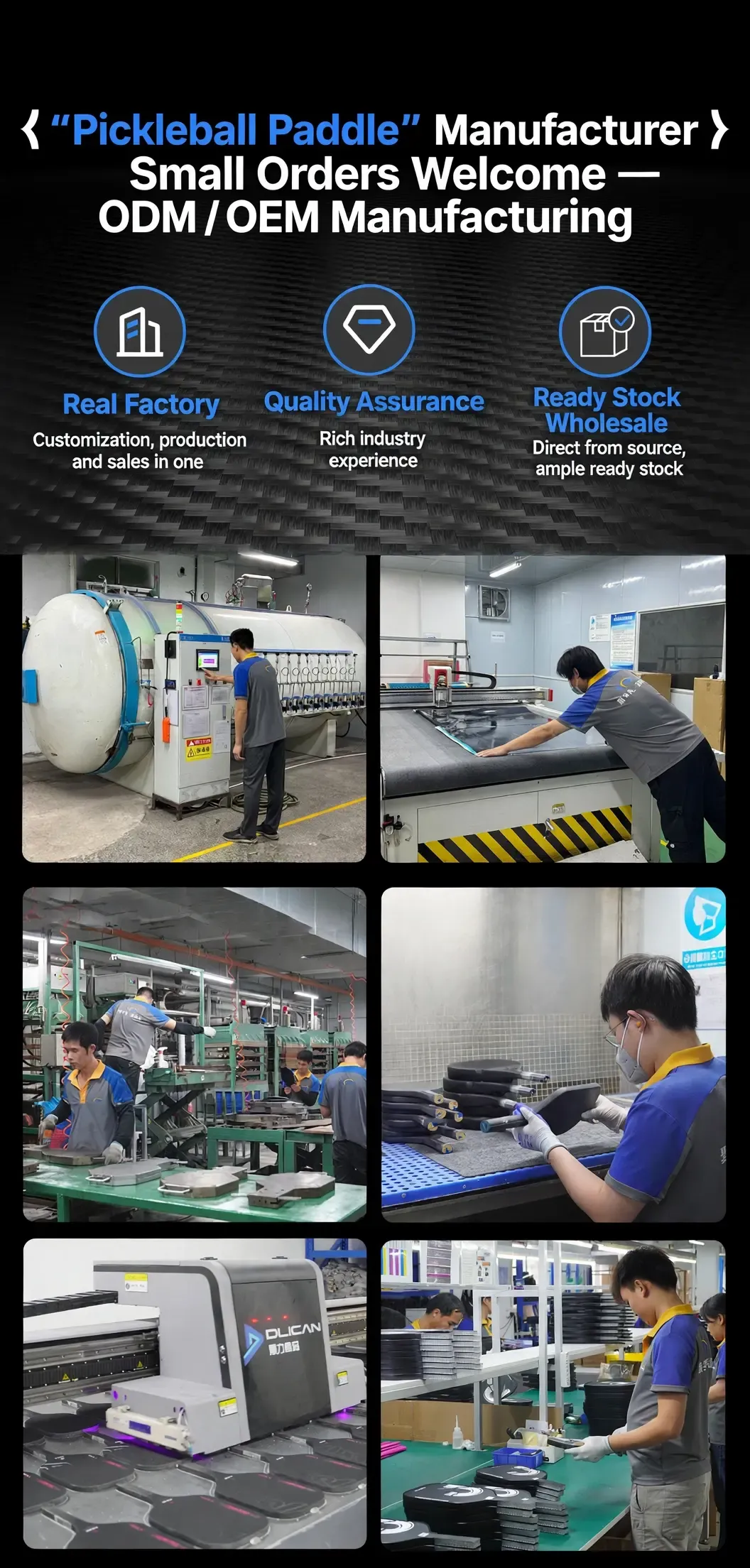
- CNC cutting: A high-precision CNC cutter cuts the prepreg automatically. Programmed cutting paths maximize material use and keep every cut piece accurate to the millimetre, matching the mold.
- Manual layup: Technicians then lay the cut pieces by hand, at set angles, layer by layer. Precise positioning between layers keeps the fiber direction exact, which is what protects the paddle's mechanical performance.
Cutting is automated for accuracy; layup stays manual because fiber direction is a craft decision, not just a machine setting.
3. Hot-press molding
Once the layers are stacked, the semi-finished paddle goes into a mold.
In hot-press molding, the layered blank is placed precisely in a high-temperature, high-pressure mold. A set temperature and pressure cure the resin fully and set the paddle blank into its designed face shape. Temperature and pressure are controlled precisely so that the carbon fiber layers bond tightly together and the structure stays solid.
This is the mainstream process for high-end paddles: the materials fuse closely, consistency is high, and performance is stable from paddle to paddle.
4. Precision trimming and polishing
After molding, the paddle is not yet finished.
- A CNC machine trims the molded paddle to millimetre accuracy, removing flash and excess edges.
- The face and the frame edges are finely polished, so the surface is smooth and the dimensions stay within tolerance.
This step is what gives a paddle a clean outline and a flat, even face — the base for coating and assembly.
5. Assembly and full quality control
The last stage is assembly, by hand, followed by checking.
Workers install the handle, the throat protection, and the edge guard. Each finished paddle is then checked across weight, balance point, and appearance, and any paddle that fails is removed. The goal is that the paddle a buyer receives performs and looks the same as the sample they approved.
Typical checks at this stage: weight, balance, surface defects, and edge and handle fit.
6. Face materials: carbon fiber vs. fiberglass
The face is the first thing a player feels, and the material sets the character of the paddle.
- Carbon fiber — the high-end mainstream material. High strength, light weight, direct power transfer, and precise control feedback. Different grades perform differently, so buyers should ask which grade is used. Best for advanced and competitive players.
- Fiberglass — the economical entry material. Good toughness, soft control, and easy handling. Best for beginners and leisure players.
In the source deck, the two finished examples are:
- Cold-pressed fiberglass paddle: High-strength fiberglass composite, cold-press formed. Durable, with solid basic performance. A classic choice for entry-level paddles — soft feel, stable control, and easy to start with.
- Hot-pressed carbon fiber paddle: High-modulus carbon fiber, formed in one piece under high temperature and high pressure. Rigidity and toughness are greatly improved, giving professional-level performance — light, powerful, and direct in power transfer. The standard choice for advanced players and competition.
7. Hot-press vs. cold-press
- Hot-press: Materials fuse tightly, consistency and performance are high. The mainstream process for high-end paddles. Higher cost, higher performance.
- Cold-press: A simpler process with lower cost. Used for entry-level or value paddles. Performance is solid for beginners, but it does not reach the same rigidity and consistency as hot-press.
8. The core: what is inside the paddle
The core decides much of the feel — power, softness, vibration, and control. The common types in the source deck are:
- Honeycomb core — the common structure. PP (polypropylene) honeycomb is cost-effective and is the mainstream base core. Nomex honeycomb performs better and is mostly used in high-end paddles.
- Foam core — soft feel. Soft hitting feel and good shock absorption. Used in leisure paddles.
- MPP core — modified polypropylene. Combines the softness of foam with the elasticity of honeycomb.
Cores have also evolved over time, in a general progression that buyers will see described in different ways by different makers:
- Early, simple cores — a basic modified-polypropylene core, with a simple structure, basic elasticity and durability. Solid feel, suited to beginners building a basic hitting sense.
- Hexagonal honeycomb cores — introducing a hexagonal honeycomb structure, improving the strength-to-weight ratio and energy return. More elastic, crisper feel. The mainstream base core.
- Optimized honeycomb cores — optimizing the thickness of the honeycomb walls and the node connections, further improving energy transfer and stability. Clearer feedback, stronger control, more stable power output.
- Advanced polymer honeycomb cores — using more advanced polymer materials and a precision honeycomb design, combining high strength with strong energy feedback. The best energy return, control precision, and shock absorption in this progression, suited to professional competition.
Note for buyers: the generation names for cores differ between makers and are not an industry standard. Ask a supplier what the core is actually made of — PP, Nomex, foam, or MPP — and how it was built, rather than relying on a generation label alone.
9. Ergonomics: the grip
The grip is often overlooked, but it decides comfort in a long match. The source deck describes optimizing grip size and feel, and using professional anti-slip grip tape to reduce hand fatigue during long play and to keep stability and control in high-intensity rallies.
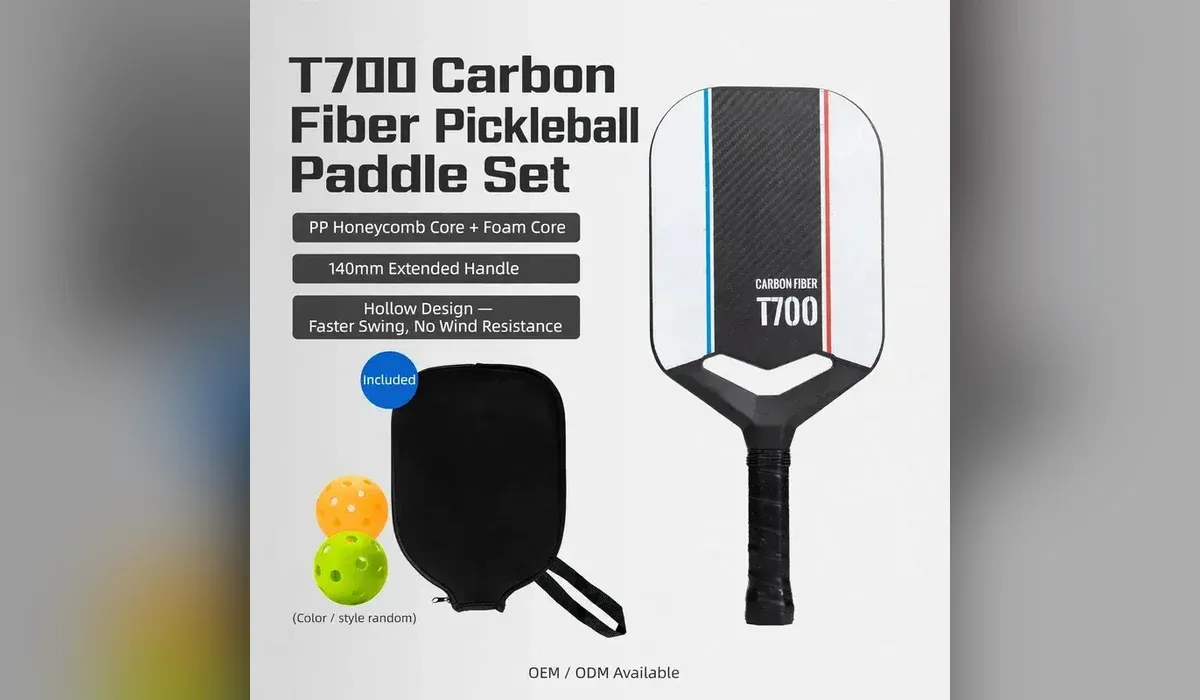
When you evaluate a paddle, check the grip size, the feel of the tape, and whether the handle length suits your game. Our T700 example uses a 140 mm extended handle, which gives more reach and leverage for two-handed or power shots.
10. What to check before you order
For distributors, wholesalers and brand owners, these are the checks that matter most:
- Face material and grade: Carbon fiber or fiberglass, and which grade.
- Process: Hot-press for high-end consistency, cold-press for entry-level value.
- Core: PP honeycomb, Nomex, foam, or MPP — and what feel it gives.
- Size and weight: Our T700 example is 423 × 185 × 13 mm and 230 g. Ask for the same figures for any paddle you source, and check them batch by batch.
- Balance and QC: Weight, balance point, and appearance should be checked on every paddle, not just on a sample.
- Customization: Face printing, handle, edge guard, and packaging can all be customized under OEM/ODM.
For buyers
Our example paddle — T700 Carbon Fiber Pickleball Paddle Set, Control / Attack — is 423 × 185 × 13 mm, 230 g, T700 carbon fiber, with a PP honeycomb + foam core and a 140 mm extended handle. The set includes 1 pc paddle + 1 pc storage bag + 2 pcs balls (colour / style random). It is neutral / unbranded — add your own logo and packaging. OEM/ODM and small-order customization are available. MOQ is 1 set. No prices are shown on this site — please send an inquiry for a quote and samples.
Related products: T700 Carbon Fiber Pickleball Paddle Set – Control / Attack